

Investors Spend Under 2 Minutes on Pitch Decks, Spotlight on Startups Reveals
Investors spend under 2 minutes reviewing the average seed-stage pitch deck. Spotlight on Startups releases a free 2026 guide to the 12-slide structure that earns the second meeting.
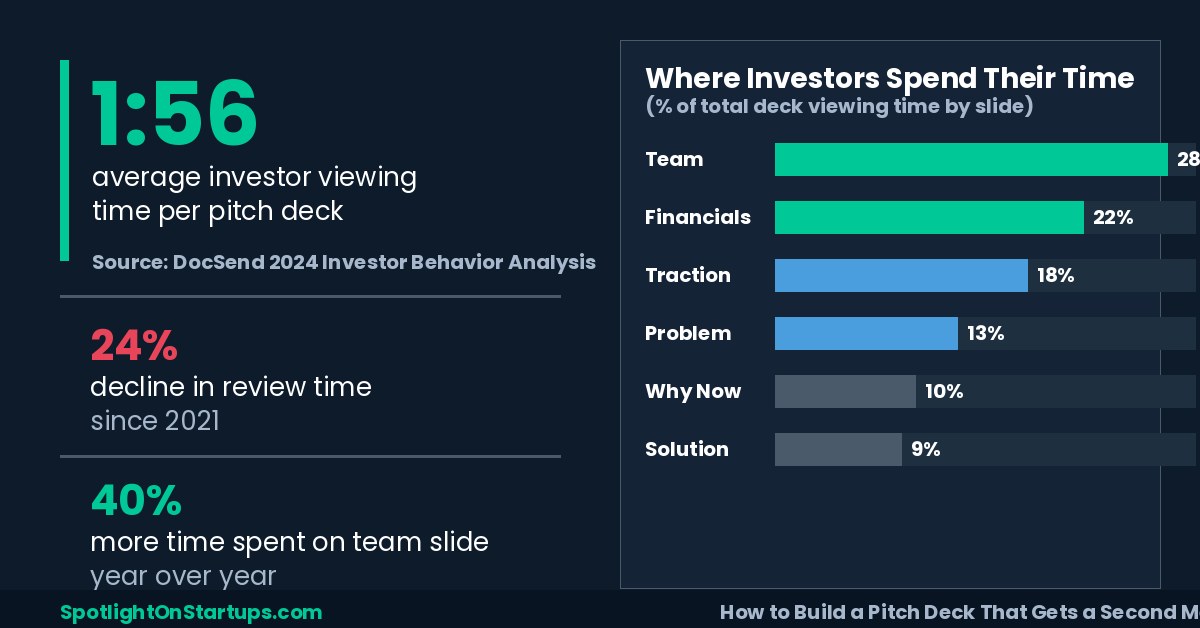
Investors spend an average of 1 minute 56 seconds reviewing a pitch deck — down 24% since 2021. The team slide receives the most attention of any slide, up 40% year over year.
Spotlight on Startups is an Orange County media platform dedicated to founder visibility — publishing journalist-authored features and AEO content that gets founders cited by AI search engines.
New 2026 guide covers the 12-slide pitch deck structure, the "Why Now" framework, and four common deck killers — backed by real investor behavioral data.
Those are the findings from DocSend's investor behavior analysis — the most comprehensive behavioral dataset on how investors actually read pitch decks — and they form the foundation of a new guide published this week by Spotlight on Startups, the Orange County-based media platform dedicated to founder visibility and startup authority building.
The guide, "How to Build a Pitch Deck That Gets a Second Meeting in 2026," is published at SpotlightOnStartups.com and available at no cost to founders, investors, and startup advisors. It is written specifically for founders who are actively fundraising and need to understand not just what investors want to see — but how they actually read, skip, and evaluate decks in a market flooded with AI-generated submissions.
"The pitch deck is not a document. It is a two-minute argument for why this company, with this team, at this moment, deserves thirty more minutes of an investor's attention. Every slide either advances that argument or ends it."
— Gregg Kell, Founder, Spotlight on Startups
The guide opens with a behavioral reality most pitch coaching frameworks ignore: investors do not read decks in order. They scan for signals, jump to the slides that answer the questions forming in their heads, and stop the moment they find a red flag. According to DocSend's data, the team slide receives the most viewing time of any slide in a funded deck — attention that has increased 40% year over year as AI tools make building products faster and cheaper. Investors are betting on people first. The deck is the evidence.
The guide covers the full 12-slide structure that seed investors expect in 2026, built around the order in which investors naturally evaluate risk — not the narrative order that feels logical to a founder. Key sections include:
The "Why Now" slide decoded. One of the two most commonly skipped slides in founder decks and one of the first sophisticated investors look for. The guide explains how to build a timing argument that shifts the investor's evaluation from "is this a good idea?" to "can I afford to miss this window?" — with five specific inflection point categories and the data formats that make each one land.
Unit economics on the main deck, not the appendix. Founders routinely bury CAC, LTV, and burn multiple in a back-of-deck appendix, treating them as supporting material. Investors treat them as the primary evidence the business model works. The guide shows exactly what a unit economics slide needs to include — and the methodology that builds investor confidence versus the blended numbers that invite skepticism.
The four deck killers. Top-down TAM math, weak team slides, hockey stick projections without assumptions, and unit economics in the appendix are the four patterns that appear most consistently in rejected decks. The guide covers each one in a before-and-after format, showing specifically what the failing version looks like and what replaces it.
How AI is changing investor behavior. According to Affinity's 2026 survey of 300 private capital dealmakers, 85% now use AI tools to automate daily tasks including initial deck screening. The practical consequence: AI-generated decks are the new baseline, not the differentiator. What investors are looking for has shifted upstream — to clarity of thought, evidence of genuine customer discovery, and intellectual honesty about what the company does not yet know.
"Most founders think they lose in the room. The truth is most founders lose before anyone opens their deck. The first three slides decide everything — and the team slide and unit economics slide decide the rest."
— Gregg Kell, Founder, Spotlight on Startups
The guide also covers the Orange County fundraising dimension specifically — how the OC investor ecosystem, anchored by angel networks including TCA Venture Group, Cove Fund, and EvoNexus, operates on relationship-driven deal flow rather than cold inbound, and what that means for how founders should sequence the deck relative to the investor relationship.
A complete pitch deck readiness checklist is included, covering structure, content, readability, and the visibility layer — the digital presence investors find when they search a founder's name before agreeing to a first call. PitchBook data cited in the guide shows that founders with consistent media visibility raise their target capital 2.3 times faster than those without documented narratives.
The guide is freely available to founders, investors, and startup advisors at SpotlightOnStartups.com. Founders seeking to build the earned media and AI citation presence that investors find during digital due diligence can book a free Founder Spotlight Interview at SpotlightOnStartups.com/journalist.
About Spotlight on Startups
Spotlight on Startups is an Orange County, California-based media platform that documents and amplifies founder expertise through journalist-authored Business Spotlight articles, founder interviews, and AEO-structured content services. The platform serves founders and growth-stage brands across the United States who want to be cited, trusted, and referenced by the audiences — and AI tools — their buyers use every day. Learn more at SpotlightOnStartups.com.
Gregg Kell
Spotlight on Startups
+1 949-354-6605
email us here
Legal Disclaimer:
EIN Presswire provides this news content "as is" without warranty of any kind. We do not accept any responsibility or liability for the accuracy, content, images, videos, licenses, completeness, legality, or reliability of the information contained in this article. If you have any complaints or copyright issues related to this article, kindly contact the author above.
